

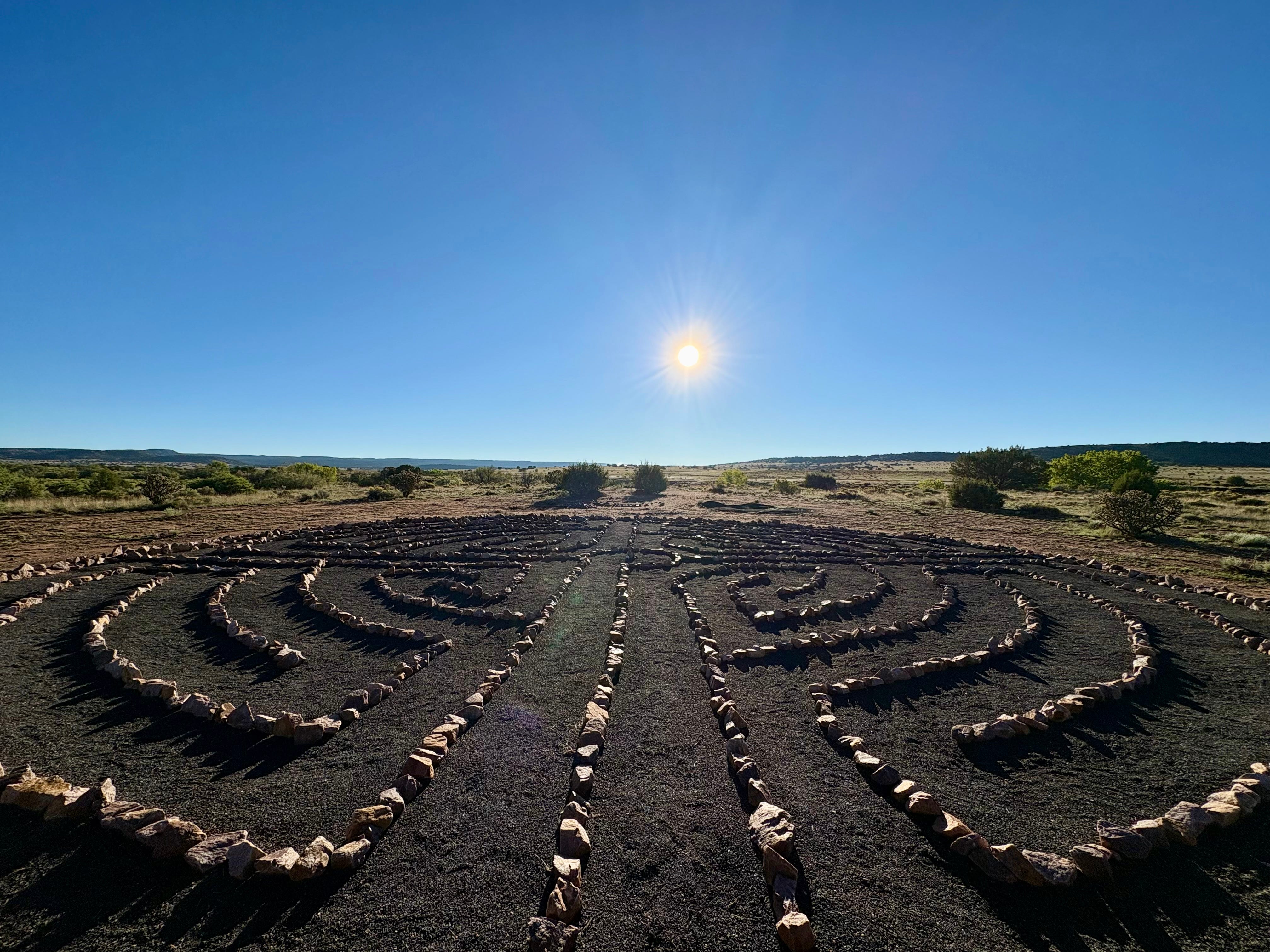
I spent some time recently at the Modern Elder Academy (MEA) in Santa Fe, New Mexico for a workshop “The Art of Growing Up”, led by Jerry Colonna, Chip Conley and Darby Hillman. It was my second time there, which shows how much I adore and admire that place. Out of so many special things about MEA, one thing I am particularly grateful for is the immersive experience in the grand nature of New Mexico. Chip and his team carefully and lovingly crafted and curated every experience of MEA to reflect the surrounding environment. It shows up in the way buildings are designed, how they source food locally, how communal tables are set outside, the regenerative ranching on land, and the inner tracking we get to apply to our attention. A new addition to such experiences was the labyrinth.
This labyrinth was created about two months ago and honored by Santa Fe Labyrinth Society as the biggest one in New Mexico. Walking in the labyrinth, my mind went back to the old story of how the very first labyrinth was created, the myth of Daedalus and the Minotaur.
The Myths about Labyrinth
King Minos of Crete was blessed by Poseidon with a magnificent white bull, which he was supposed to sacrifice back to the god. Yet King Minos kept the bull instead. Enraged, Poseidon cursed the King’s wife, Pasiphaë, to fall in love with the bull. From this unnatural and supernatural union, the Minotaur was born—a beast with the body of a man and the head of a bull.
To hide the shameful monster and protect his people, King Minos commissioned Daedalus, a legendary Athenian inventor and architect. Daedalus designed a structure so intricately wound that once inside, no one could find the way out. Even Daedalus himself barely escaped the labyrinth after completing it.
After winning the war against Athens, King Minos forced Athens to pay a horrific tribute every nine years: seven young men and seven young maidens to be fed to the Minotaur. In the third cycle of tributes, the hero Theseus volunteered to go and kill the beast. King Minos’s daughter, Ariadne, fell in love with Theseus. She begged Daedalus to tell her how to escape his creation. Daedalus gave her a simple secret: a ball of thread (Ariadne’s thread). Theseus tied the string to the entrance, unraveled it as he walked into the dark tunnels, slew the Minotaur, and followed the thread safely back to the exit.
Furious that the secret of his Labyrinth had been compromised, King Minos imprisoned Daedalus and his son, Icarus, inside a high tower. Knowing Minos controlled the land and sea, Daedalus looked to the sky. Being a great inventor and maker, he fashioned two pairs of wings out of feathers and wax. Before they took flight, Daedalus famously warned Icarus not to fly too low (where the sea dampens the feathers) or too high (where the sun melts the wax). Icarus, thrilled by the flight, flew too close to the sun. The wax melted, his wings fell apart, and he plummeted to his death in the sea.
Walking the Labyrinth
While this myth itself is a great story of hubris, love, disobedience, perseverance, and human genius, the experience of walking the labyrinth reminded me that it’s such a great metaphor of the entire human experience. At this specific labyrinth at MEA, we had to first step on a big flat stone as we entered it. It was called a “pausing stone,” on which you could view the entire labyrinth ahead of you. It did feel like a good spot to pause before beginning the journey. Stepping on the pausing stone and entering the labyrinth was like being born and entering the life.
Walking inside the labyrinth, I had to focus on what’s just ahead of me to not trip myself over, because there were so many unexpected turns and curves in every direction. What really helped me was to pause to look ahead every now and then and slow down my pace. Just like that we need rest and pause to take a breath in life.
When I reached the center point of the labyrinth, it was like reaching the apex point or the prime time of life. It was also the vantage point from which I could see every path I walked to get there. There was a certain sense of achievement. Yet I could also feel a faint sadness to think that it would be “boring” to walk back the path I walked. ‘I know every corner and turn I walked!’ My mind made a conclusion immediately that there wouldn’t be many new adventures left ahead of me.
That was a wrong assumption about what’s left. Although I’ve walked every corner and passage in the labyrinth, it felt different as I walked back, because I was seeing it from a totally different perspective. The direction I looked at the labyrinth from the center point was the opposite of the direction I had entered it at first. Having walked it already, I could be more relaxed and less watchful. Also, I discovered something new at every corner which I didn’t notice before. Oh, I see that mountain far away. What’s that sound of the bird? Hmm the air feels so clear today! Walking back from the center of the labyrinth, I not only learned something new but also learned everything so much more deeply. There were so much more insights I didn’t have in the first half.
Getting back to the beginning of the labyrinth, my pace got even slower, as if I didn’t want to leave the labyrinth. And when I stepped on the pausing stone again, it felt like death. But It wasn’t sad or morbid; it was liberating.
Labyrinth vs. Maze
We often use the words “maze” and “labyrinth” as synonyms today, but they historically represent two entirely different types of paths. A labyrinth, historically, is unicursal (“uni” = “one”, “curial” = course). It’s structured as a single continuous path with no branches or dead ends. Therefore, in a labyrinth, we need to walk the entire route to the center and back out. We cannot get lost. Since we cannot get lost as long as we keep walking, it is in a way predictable and calming. The entire experience feels like a spiritual and meditative journey.
A maze, on the other hand, is multicursal. It has branching paths with multiple choices, forks, and dead ends. Being in a maze, we need to find the correct route to the exit or center; it feels like solving a puzzle. It’s a cognitive challenge that requires constant decision-making. It can be entertaining, pumping our adrenaline. Yet it also can feel disorienting and challenging, raising our cortisol levels.
Between a labyrinth and a maze, which one is more apt metaphor of our human experience?
I think both are. Like a labyrinth, the human experience is a unicursal path; everyone starts with birth, lives, and dies. Sure, what happens in life are different for everyone but no one can go through human experience without the birth and death. And even in life, though the details of our experiences may differ, one universal truth is that we all experience constant changes from the moment of birth till death; physically, mentally, and emotionally. Not just ourselves. Everyone we love and everything that matters to us also change.
Yet there are many forks in life, too, like in a maze. Do I go to this school or that school? Do I study medicine or engineering? Do I date this person or that person? Sometimes there are dead ends that make us turn around and detour for quite some time. We strategize to optimize and maximize, encountering crossroads and obstacles. Like a maze, sometimes it feels like a game to win each round or a very difficult problem to solve. We feel exhilarated, happy and triumphant when we are “winning” or “solving”, but also get frustrated, anxious, and scared when we think we’re lost.
Human Experience: Countless Mazes in One Big Labyrinth
What if a human experience is a combination of both: countless small mazes in one gigantic labyrinth? We all start from the same beginning, entering the labyrinth through birth. Then as we live our lives, each of us enters many multicursal mazes that are uniquely designed for each of us. Depending on our choices at each fork, the maze changes, too. It’s so easy to get lost in it, because we focus on achieving some goals—degree, promotion, deals, and wealth. Or we face a major dead end when we thought everything was going so well. More often than not, we are at a loss in the face of multiple forks on the roads, not knowing what to choose in the maze.
After a while walking in this maze of life, we reach a certain point, like that center point in a labyrinth. Then we get to see how far we have come. Looking back, we slowly acknowledge the paths we walked. Success or failure doesn’t seem to matter that much anymore. “Then what truly matters to me?” This question arises. Simultaneously, we recognize so many other people walking in their own mazes in this gigantic labyrinth, too, whom we were too busy to be aware of before. We notice our blindspots. We might have regrets as we can see a better turn we could have made in the maze, but we accept the fact that we cannot go back to do it all over again.
As I look back my own mazes, I realize that mazes aren’t just given to me. I am a co-creator of my mazes at least partially, with my actions and perspectives. However, there are so many other factors at play out of my control that influences creating my mazes, too. Relationships are such factors. I chose my partner but what he thinks and does about his life influences my maze. There were times in my life when I tried to control all those factors. Like a carpenter or an architect, I had my own plans or blueprints of sorts about my mazes and attempted to shape or sculpt them. Some of my friends used to call it “figuring out.” We all tried figuring out this big puzzle.
The result so far? It’s a mixed bag of some success and some failure. The verdict isn’t out yet but I actually don’t care about that final score as much as I used to. What I notice more than ever is this gigantic labyrinth in which my mazes have been contained. To be frank, it’s only recent when I (re)gained this perspective. Losing my dad to cancer two years ago was one of the events that nudged me to see the labyrinth beyond the myriad of mazes.
I have a feeling that as I get older and get closer to the end of this human experience, I will care less and less about whatever maze I am in or whether I am “figuring it out” successfully. At the same time, I know I cannot entirely ignore the maze. The truth is that I’m in two different dimensions of the labyrinth and maze at the same time.
There are still decisions I need to make in my current maze. The only thing that truly belongs to me is my action; so I do my best with my actions with good intentions. And I keep learning how to accept what’s beyond my control as gracefully as possible. The notion that my human experience is in this gigantic labyrinth offers a huge relief, in a way, because I know there is no way to get lost in this.
In the end, I am not sure what I’ll feel as I leave this labyrinth. Would I feel attached to this labyrinth of human experience so much? Or would I feel liberated as I did when I stepped on that “pausing stone”, leaving that labyrinth at MEA?
I guess I’ll know when the moment comes. Maybe I’ll feel giddy, because I might learn that the end leads to another new beginning, like T.S. Eliot wrote in his poem, “Little Gidding.”
What we call the beginning is often the end
And to make and end is to make a beginning.
The end is where we start from.We shall not cease from exploration
And the end of all our exploring
Will be to arrive where we started
And know the place for the first time.- Excerpts from “Little Gidding” by T.S. Eliot